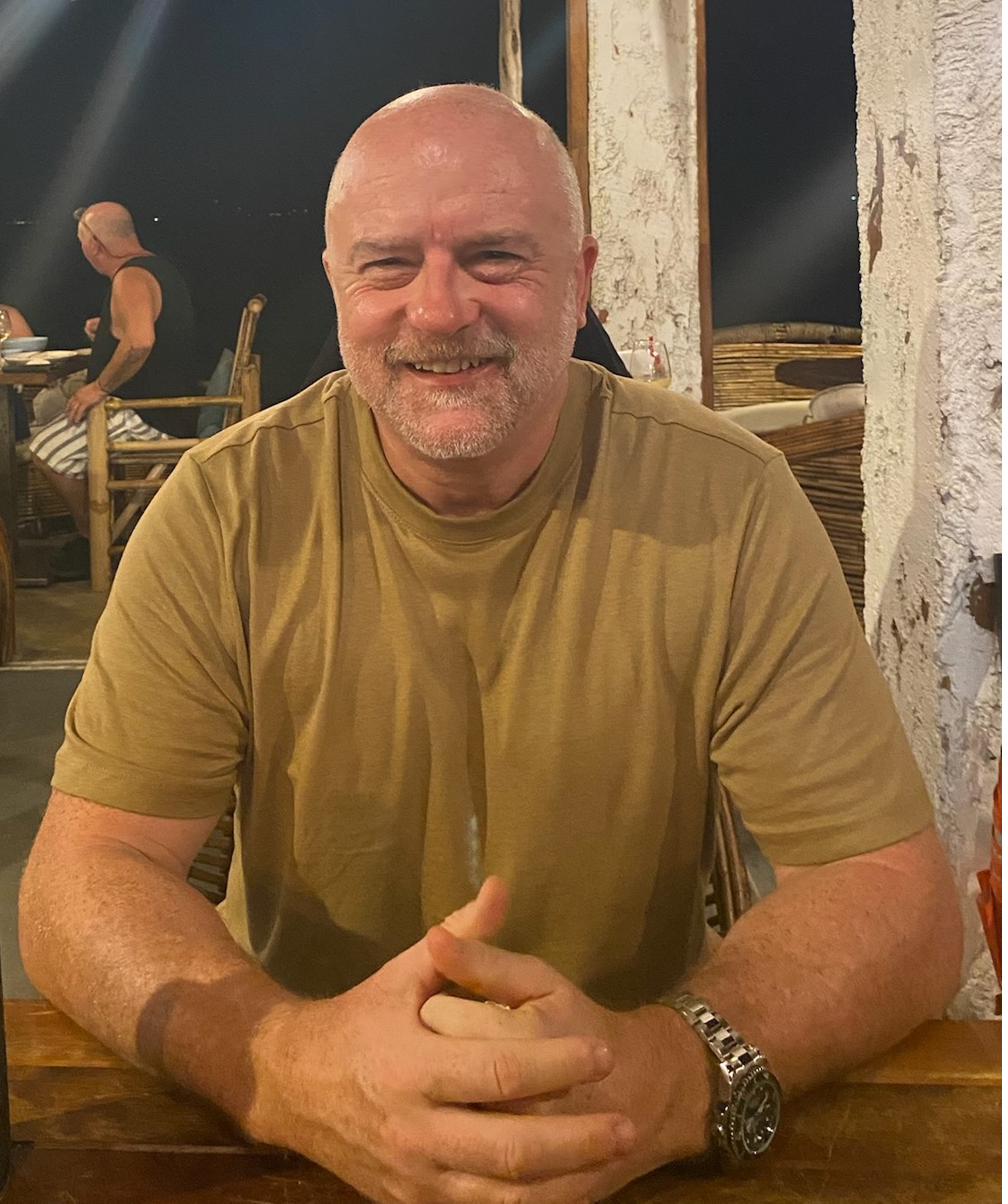
The moment everything changed
I left school at sixteen with one grade C GCSE. That was it. My sister was always the academic one, quietly brilliant, straight As, destined for university. I was the other one. The one who never quite found his footing, never quite believed school had much to offer him. So I left.
For two years I worked as a forklift driver. That wasn't accidental, it was the plan. My dream, from as far back as I can remember, was to become a truck driver. The forklift job was the stepping stone, the route in. I was within touching distance of starting the training. And honestly? Even now, decades later, I sometimes wonder if there's something in that life I'd still find deeply satisfying. There's nothing wrong with that dream. It just turned out not to be the only one I had.
A colleague, thirty-six years old, who had never left the firm he'd joined straight from school, his potential long since calcified into bitterness, looked at me one day and said, with no kindness whatsoever: "You're only here because you're stupid."
It wasn't meant to be motivating. It was spite from someone whose own ceiling had closed in and who wanted company down there. But it lit a fire in me that has never gone out.
I remember exactly where I was standing. I remember exactly who he was. And I remember the decision I made in that moment. I quit, walked away from a man's wage at seventeen years old, and went back to college. I sailed through everything. And from that point I never stopped.
For years I carried real anger toward him. Then I realised something: I'd long since overtaken everything he could ever have imagined for himself, and he'll never know he was the reason. He had no intention of turning my life around. But he did. And I'm grateful.
My sister and I became the first generation in our family to go to university. We both left with first class honours degrees, something our parents were enormously proud of, and so were we. I went on to qualify as a chartered accountant and found my way into management consulting, advising major financial institutions across the UK, Europe, and globally. I was involved in some of the most significant financial events of the era, including the winding up of Lehman Brothers after its collapse in 2008.
I grew up working class. Money was never abundant but it was always respected. My father was meticulous about it, every penny accounted for, every decision made carefully. He never talked about money as his. It was always the family's money. That distinction shaped everything about how I think about financial responsibility.
And through the career I was doing the "right things." Paying into pensions. Investing in property. Building the financial foundations I was supposed to build. Ticking every box. Following every piece of conventional wisdom about how to create security.
My father never talked about money as his. It was always the family's money. That distinction shaped everything about how I think about financial responsibility, and why I built Poreia.
The career that consumed everything
The consulting career came at a cost I kept underestimating. Excessive travel. Constant pressure. A life that had gradually been taken over by work until there was almost nothing left outside it. My kids were growing up and I was barely there. I couldn't get to things. I couldn't live the local, present life I'd always wanted.
It wasn't a dramatic crisis. It was a slow, accumulating realisation that the path I was on wasn't leading where I actually wanted to go. The career was successful by every conventional measure. But success by someone else's definition isn't the same as a life that fits.
When voluntary redundancies were offered, I recognised the moment immediately. This was the window I'd been waiting for. Not a leap into the unknown, a calculated decision. The redundancy package gave me seed capital. I had skills, experience, and a clear problem I wanted to solve: I wanted to build something where I controlled my time, was present for my children, and could finally live on my own terms.
I used that redundancy money as the deposit that launched Urban Jump. It wasn't reckless. It was the most deliberate financial decision I'd ever made. I just had no idea what was coming.
What nobody tells you about running a business
There is an enormous difference between advising businesses and running one. I had spent years telling other people how to manage their operations, their finances, their strategy. I thought I understood business. I did not.
When you're in the hot seat, everything changes. Cash becomes everything. Not revenue, not profit. Cash. The actual money in the account on a Tuesday morning when payroll is due on Friday. I learned more about real financial management in the first six months of running Urban Jump than in the previous decade of consulting.
There were moments of genuine fear. Creditors calling. Cash running dry. Lying awake at three in the morning trying to figure out how to keep things alive for another month. I was doing everything I could, restructuring, refinancing, negotiating, fighting, but the business was consuming everything I had. The pensions I'd built, the property equity, the financial foundations, all of it existed but none of it felt accessible or coherent. I had assets and no clarity.
The hardest part wasn't the money. It was the isolation. Running a business is brutal and it is largely done alone. There was no one who truly understood the specific combination of financial complexity, personal exposure, and relentless pressure I was carrying. I had all the qualifications and all the experience and I still felt like I was navigating in the dark.
Only the strongest survive in business, not because of talent or intelligence, but because of resilience and resourcefulness. You have to be ready for how brutal it really is. Nobody tells you that until you're already in it.
The decade, the exit, and what came after
I survived. More than survived. I built Urban Jump into a business substantial enough to sell. A decade of fighting, restructuring, and refusing to give up culminated in a trade and asset sale that closed in April 2026. That exit was the result of applying every ounce of my financial and structural thinking to the most complex problem I'd ever faced.
And in the months that followed, I sat down and did something I should have done years earlier. I built a complete, honest picture of my entire financial position. Every asset. Every liability. Every pension pot. Every tax implication. The full picture, properly structured, with a clear plan for what to do with each piece.
The clarity that came from that exercise was extraordinary. Not because the numbers were particularly impressive. But because for the first time in years, I could see exactly where I was and exactly what to do next. The anxiety that had been a constant companion for a decade started to lift.
That document, that structured framework for seeing your complete financial picture clearly, became the foundation of everything Poreia is built on. It was the thing I needed at thirty-five that nobody gave me.
Why Poreia exists
At fifty, something shifted. My aspirations weren't the same as they'd been at thirty or forty. I didn't want to keep running harder. I wanted the life I'd been building toward to actually start. Less stress. More peace. The freedom to choose how I spent my days rather than obligation choosing for me.
Still ambitious. Still driven. But differently. I wanted to make the fruits of everything I'd worked so hard for actually work for me. To derisk. To build something that created genuine security rather than just the appearance of it. To stop surviving and start living deliberately.
And I realised that what I'd built, the framework, the methodology, the hard-won understanding of how financial clarity actually changes everything, was exactly what countless other people in their forties and fifties needed and didn't have.
Professionals who've done the "right things" and still feel exposed. Business owners who've built something real but can't see how it all adds up to security. People whose aspirations have shifted but who don't have a clear path to the life they actually want. People who are where I was.
Poreia is built for them. It's built from lived experience, not theory. It doesn't offer generic advice or motivational fluff. It offers a framework that works because I built it for myself first, in the hardest circumstances, and it changed everything.
The name comes from ancient Greek: poreia means purposeful forward movement. The journey toward something. That's what this is. Not running away from where you've been. Moving deliberately toward where you want to be.
I was that person: capable, experienced, doing all the right things, and still unable to see clearly how it all added up to the life I actually wanted. I found a way through. I want to help you do the same.
Richard Hand, Founder, Poreia